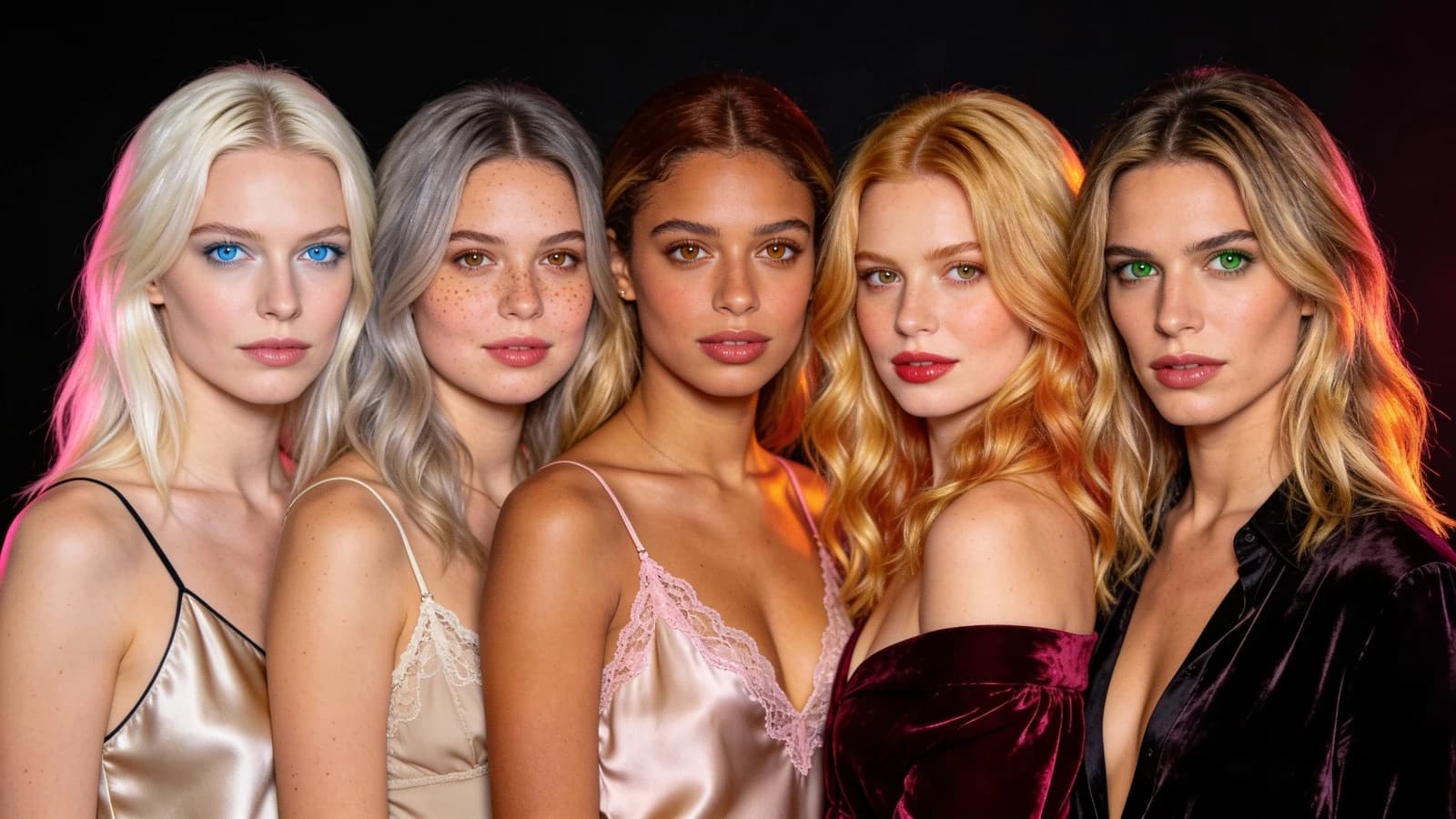
A plain-language guide to every blonde tone, what sets them apart, and how to recreate the exact one in AI.
Blonde might be the most misunderstood hair color there is. People say "blonde" like it names one thing, but ask ten people to picture a blonde and you get ten different women. Platinum is not honey. Ash is not golden. The distance between them is the difference between cool and warm, soft and sharp, girl-next-door and runway.
This is a plain-language guide to the main shades of blonde, what actually separates one from another, and how to land the exact tone you have in your head.
Blonde is a spectrum, not a single label. It runs from near-white platinum, through dozens of tones, down to the edge of light brown. Only two things move a shade along that spectrum: how light it is (the level) and whether it leans cool or warm (the undertone). Pin those two down and you have named your shade. Leave them vague and "blonde" comes out looking generic.
Most people already have one exact tone in mind. When someone says they have a thing for blondes, they almost always mean one specific version, even if they cannot put a word to it. The vocabulary below is the fastest way to turn a fuzzy "blonde" into something precise.
Here are the tones people mean most often, running from the lightest and coolest to the darkest and warmest.
The lightest, coolest end of the scale. Platinum is near-white with a silver or icy cast; bleach blonde is the high-contrast, heavily processed version of it. Both read bold and high-maintenance, and both pop hardest against pale skin and light eyes.
Cool blonde without the drama. Ash blonde carries a smoky, gray-leaning undertone that cancels out brassiness, while beige sits right on the line between cool and neutral. These are the muted, expensive-looking tones: less flashy than platinum, still clearly cool.
The warm middle of the range. Honey is a soft, golden-brown blonde; golden is brighter and sunnier. Both skew warm and approachable, and on an AI companion this is the tone that tends to read a little older and more grown, which is part of why it shows up so often on a milf ai character.
Blonde with a red whisper. Strawberry blonde blends pale blonde with a warm ginger tint; rose blonde nudges it toward soft pink. Both are rare in the wild, which is exactly why they stand out.
The realistic, everyday end. Dirty blonde is a darker, muted blonde with brown woven through it; bronde is the brown-and-blonde blend a shade past that. These look the most natural and are the tones most people actually walk around with.
Undertone does more work than lightness. The same level reads completely differently warm versus cool: a warm platinum looks buttery, a cool platinum looks icy. When a blonde looks somehow "off," the undertone is usually the reason.
Skin and eyes change everything. Blonde never exists on its own. Cool ash flatters fair, pink-toned skin; warm honey suits golden and olive skin. Put a shade against the wrong skin tone and it fights the face instead of framing it. Eye color pulls the same lever: icy platinum over blue eyes reads nothing like honey over brown.
Light and upkeep are part of the package. Warm light pushes any blonde golden and cool light pulls it ashy, so one shade can read two ways depending on the room. Upkeep matters too: platinum and cool tones drift brassy and need constant work, while dirty blonde is close to maintenance-free.
This is where naming the shade pays off. Most AI image tools treat "blonde" as a single tag and fall back to the same yellow, sunlit result every time, which is why generated blondes so often look nothing like what you pictured. A purpose-built blonde ai generator works the other way around: you set the shade, the undertone, the cut, the skin, and the eyes separately, so the output is your tone instead of the algorithm's average guess.
Style changes the rules. In illustrated and anime work, blonde behaves differently again: brighter, flatter, more saturated, with its own conventions on an ai hentai generator. A realistic render and a 2D one need different language for what is technically the same "shade."
The real advantage is control. Generating instead of searching means you can request the exact platinum or honey and then change it whenever you want: same character, new tone, on demand. A broader nsfw ai generator covers the realistic, fully uncensored end of that.
Decide cool or warm first. Settle the undertone, then choose the level. "Cool and light" lands you near platinum or ash; "warm and medium" lands you around honey or golden; "natural and a bit darker" lands you at dirty blonde.
Then match it to skin and eyes and name it in plain words: platinum, ash, honey, strawberry, dirty. That is a brief precise enough to find the shade, or generate it, without guessing.
Blonde is not one color, it is a vocabulary. The moment you can name the exact tone you want, finding it or building it stops being a gamble. And once the look is right, the rest, the chatting, the voice, the ai sexting, is where she actually comes alive.
Want an AI anime girlfriend? We ranked the best apps for creating custom anime companions — from character design to conversation quality and roleplay depth.
Read more
Want to create your own AI girlfriend? This step-by-step guide walks you through exactly how to build a custom AI companion with the personality, look, and conversation style you want.
Read more
Looking for the best AI girlfriend app? We compare the top platforms on what actually matters: conversation quality, memory, NSFW freedom, and pricing.
Read more